Human vs AI Music Transcription: Which Produces Better Sheet Music?
AI music transcription tools can generate a rough draft of sheet music in under two minutes. But how accurate are they really? Published AMT benchmarks vary widely by task and dataset. AI can perform well on controlled solo-piano tests, with scores reaching up to 96% on pitch detection (MIREX 2024), but reliability drops on real-world material. On guitar, accuracy falls to around 78%. On vocals, roughly 52%. On a dense mix with multiple instruments, as low as 38%. And even the best pitch score still does not equal a finished human score.
And here's the part the benchmarks don't measure at all: rhythm notation, meter, dynamics, expression markings, playability, and engraving quality. Even a 96% pitch score can produce a score with incorrect rhythms and meter. When the rhythm is wrong, the music is unplayable. Missing dynamics and expression markings compound the problem, but it's the rhythmic and metric errors that make AI output fundamentally unreliable for performance. We ran a side-by-side comparison to show exactly where the gap is.
| Use AI transcription when… | Hire a professional transcriber when… |
|---|---|
| You need a rough MIDI draft to get ideas into a DAW | The score will be performed, published, or sold |
| You want quick pitch reference to check your ear against | Multiple instruments or voices are involved |
| Budget is the primary constraint and you can edit the output yourself | You need dynamics, expression markings, or chord symbols |
| The source is clean solo piano with simple, steady rhythms | The music has swing, rubato, complex meter, or irregular rhythms |
| You've spent 30+ minutes correcting an AI-generated draft |
What Is AI Music Transcription (AMT)?
AI music transcription extracts pitches from audio, but no current tool outputs rhythm notation, dynamics, expression markings, or engraving. Even a high pitch-detection score does not produce a finished score that a musician can rehearse from, publish, or hand to a student without significant manual editing.
Automatic music transcription uses neural networks to convert audio recordings into musical notation or MIDI data. A 2024 survey of machine learning techniques in AMT describes it as "a central challenge" in music information retrieval, noting that current systems have not yet matched human expert accuracy (Jamshidi et al., 2024).
A growing number of consumer tools now offer audio-to-notation workflows. Some produce only MIDI data (pitch and timing without notation), while others attempt to generate sheet music directly. Most are free or low-cost, and they work best on clean solo piano recordings with straightforward rhythms. Some target specific use cases like lead sheet creation or DAW integration rather than full transcription.
The key distinction: these tools extract notes. They don't produce finished sheet music. What comes out still needs significant human work to become something a musician can rehearse from. Some tools attempt to include dynamics, chord symbols, or expression markings, but the results are inconsistent and usually require human correction. And none publish accuracy benchmarks for anything beyond pitch detection on controlled datasets.
What Does a Professional Human Transcriber Actually Do?
A professional transcriber delivers a finished score: voices separated into readable parts, dynamics and expression markings added from the audio, correct rhythmic notation, proper engraving, and a layout optimized for sight-reading. The client receives a performance-ready result with no further editing needed.
A 2018 IEEE Signal Processing survey on AMT found that complete transcription quality involves far more than note detection. It requires "voice separation, metrical alignment, note value detection, and harmonic analysis" (Benetos et al., IEEE). That's exactly what a professional transcriber does.
In our experience transcribing thousands of pieces at Music Notation Hub, the actual note pitches are rarely the hard part. The skill is in everything around the notes, and that's what separates a rough draft from a professional score:
- Rhythmic interpretation: Correctly notating swing, rubato, fermatas, and irregular groupings
- Voice separation: Splitting overlapping lines into readable parts with proper stem direction
- Musical directions: Adding dynamics (pp, ff, cresc.), tempo markings, pedal indications, articulations, and expression text
- Harmonic analysis: Writing chord symbols, choosing correct enharmonic spellings (G♯ vs A♭)
- Layout and engraving: Proper spacing, page turns, clef choices, and publication-quality formatting
- Custom adaptation: Simplifying for skill level, adding fingerings, transposing for different instruments, extracting individual parts
The result isn't just accurate. It's usable. A performer can sight-read it. A publisher can print it. A teacher can hand it to a student without edits.
How Do AI and Human Transcription Compare? A Side-by-Side Breakdown
AI scores 0% on dynamics and expression markings, two of the eight dimensions working musicians need most. Across all eight categories we tested, only speed favors AI. Rhythmic accuracy, playability, chord symbols, presentation quality, and flexibility all require a human transcriber.
We evaluated AI transcription tools against professional human transcription across eight dimensions that matter to working musicians. Here's what we found.
| Dimension | AI Transcription | Professional Human | Winner |
|---|---|---|---|
| Pitch Accuracy | Up to 96% F1 on lab-quality solo piano. Drops to ~78% on guitar, ~52% on vocals, and 38% on polyphonic mixes. | Near-perfect. Trained ears catch enharmonic context, octave placement, and chord voicings. | Close |
| Rhythmic Accuracy | Quantizes to a grid. Struggles with swing, rubato, tuplets, and pickup bars. | Captures complex rhythms, expressive timing, and metric irregularities accurately. | Human |
| Musical Directions | Almost nonexistent. No dynamics, tempo markings, pedal, expression, or articulations. | Full markings: dynamics, rit., a tempo, pedal, expression text, rehearsal marks. | Human |
| Playability | Wrong clef assignments, awkward voice crossings, unreadable density. | Optimized for the performer: correct clefs, logical voicing, comfortable page turns. | Human |
| Chord Symbols | Rarely included. When attempted, often incorrect or incomplete. | Accurate harmonic analysis with proper jazz/pop chord notation conventions. | Human |
| Presentation Quality | Raw output needs extensive cleanup before use. | Performance-ready and publication-ready. Clean engraving, professional layout. | Human |
| Flexibility | One rigid output. Can't rearrange, simplify, or customize. | Can rearrange, simplify, add fingerings, transpose, create lead sheets or parts. | Human |
| Speed | Minutes for initial output. | Days for a finished score (but no further editing needed). | AI |
The pattern is clear. AI wins on speed. Humans win on everything that makes sheet music actually work.
It's worth noting that AI transcription does have legitimate uses. Quick MIDI extraction for getting audio ideas into a DAW, rough pitch reference for checking your ear, and low-cost accessibility for students and hobbyists are all real strengths. If you need a rough draft fast and plan to do significant editing yourself, AI tools are a reasonable starting point.
However, even on pitch alone, the numbers drop fast outside of ideal conditions. A 2025 study published in the EURASIP Journal on Audio, Speech, and Music Processing found that AI transcription accuracy drops by 20 percentage points when the recording comes from a different piano than the training data, and another 14 points for genre shifts, with total degradation reaching up to 50 percentage points in extreme cases (Martak et al., 2025). At the NeurIPS 2025 AMT Challenge, only 2 of 8 competing teams outperformed the baseline model on multi-instrument excerpts, and even the winners showed a consistent 25+ point F1 drop when just two or three instruments were present.
How Did AI Perform in Our Side-by-Side Test?
We tested Klangio AI against professional transcription on three recordings. Sample A was AI's absolute best-case scenario: clean studio recording, solo piano, steady tempo, no rubato. Even under those ideal conditions, the AI merged all voices into one layer, failed to detect the pickup bar, and threw off the entire meter from bar one. The output was not playable.
How we tested
- Tool tested: Klangio (Piano2Notes / Melody Scanner)
- Date tested: March 31, 2026
- Source audio: Three recordings: two solo piano (clean studio), one vocal melody
- Export format: MusicXML, imported into notation software for comparison
- What we evaluated: Pitch accuracy, rhythm and meter, voicing, lyrics (where applicable), musical directions (dynamics, articulations, expression), chord symbols, layout, and playability
- Comparison baseline: Professional transcription of the same audio by Music Notation Hub transcribers
To put these differences into concrete terms, we transcribed three different pieces using Klangio's AI transcription and compared each one against our professional transcription of the same audio. We chose three source types to test AI across a range of real-world scenarios.
About this piece: We deliberately chose a recording that plays to AI's strengths. Sample A is a solo piano piece from a clean studio recording with a steady tempo, clear meter, and no rubato. The harmony and melody are straightforward. There are no rhythmic tricks, no complex syncopation, and no overlapping instruments. If AI transcription is going to perform well, this is the kind of material where it should.
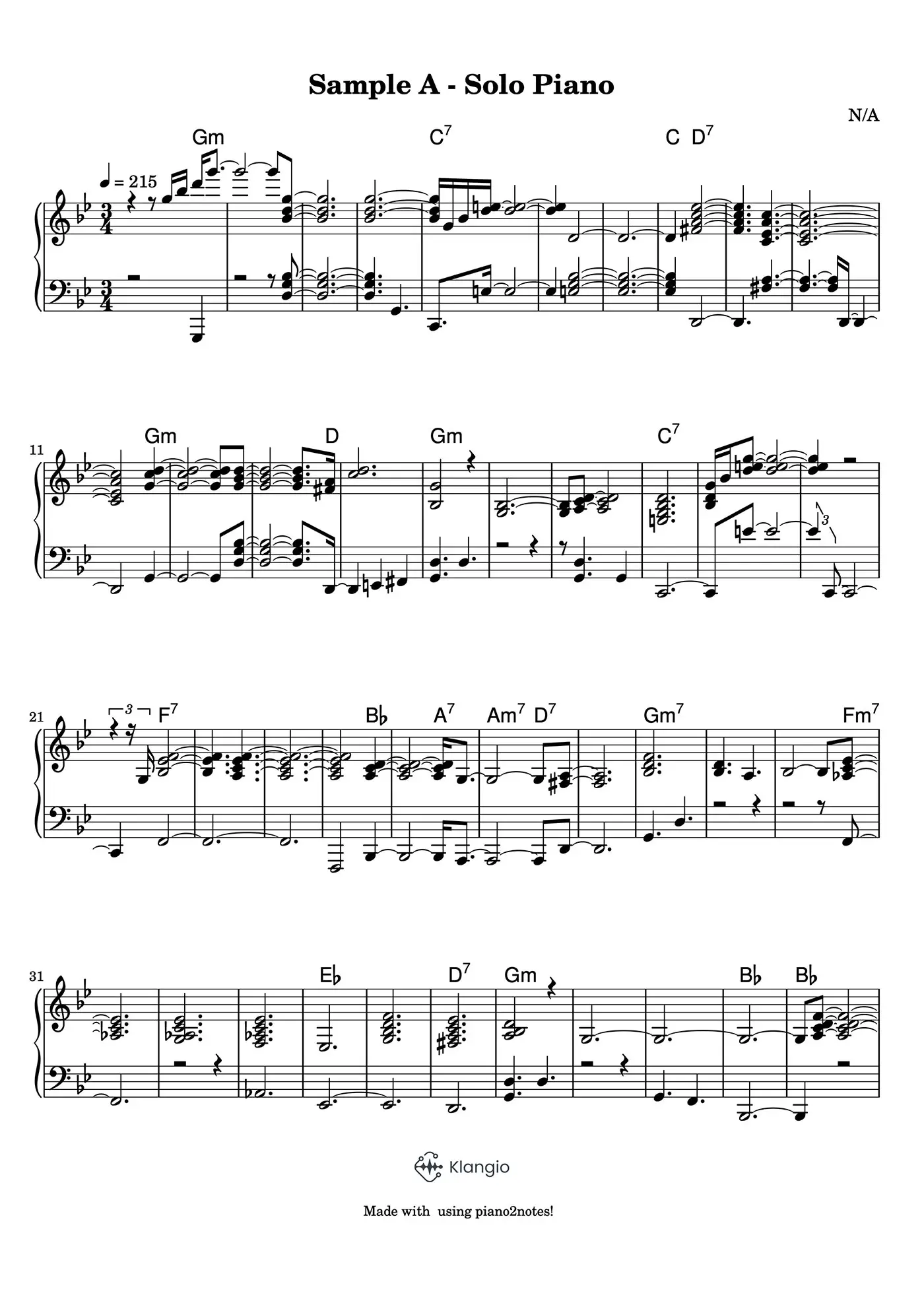

Sample A — Solo Piano: AI transcription (left) vs professional transcription (right), same source audio.
Pitch: Klangio captured most of the pitches correctly, which was expected given the clean source audio. On straightforward passages with clear note attacks, the pitch detection worked as the benchmarks suggest it should. However, everything was written in a single voice, merging the melody and accompaniment into one layer. On a piano score, this should not be the case.
Rhythm and meter: This is where the output became unusable. The resulting score is neither playable nor readable by a musician. Quarter-note arpeggios were transcribed as single sixteenth notes. The piece does not start on beat one (it has a pickup), and the AI failed to account for that, throwing the entire meter off from the first bar onward.
Musical directions and layout: The AI output contained zero musical directions. No dynamics, no pedal markings, no tempo indications, no expression text of any kind. The overall layout looks cluttered and poorly spaced. Slurs appear in the output but are assigned to the wrong voice direction, making them visually confusing rather than helpful.
Playability: As noted above, this score is not playable by a musician in its current form. For our team, it would be significantly faster to transcribe this piece from scratch than to attempt correcting the AI's output. Between the broken meter, collapsed voices, and missing musical context, there is very little to salvage.
Keep in mind: this was AI's best-case scenario. A clean solo piano recording with a clear meter, no rubato, and no harmonic complexity.
About this piece: Sample B is another solo piano recording, this time with more freedom in tempo and a different musical character. Like Sample A, it was recorded in a studio setting with clear audio quality. We selected two piano pieces to show that AI performance varies even within the same instrument category, depending on the musical content.
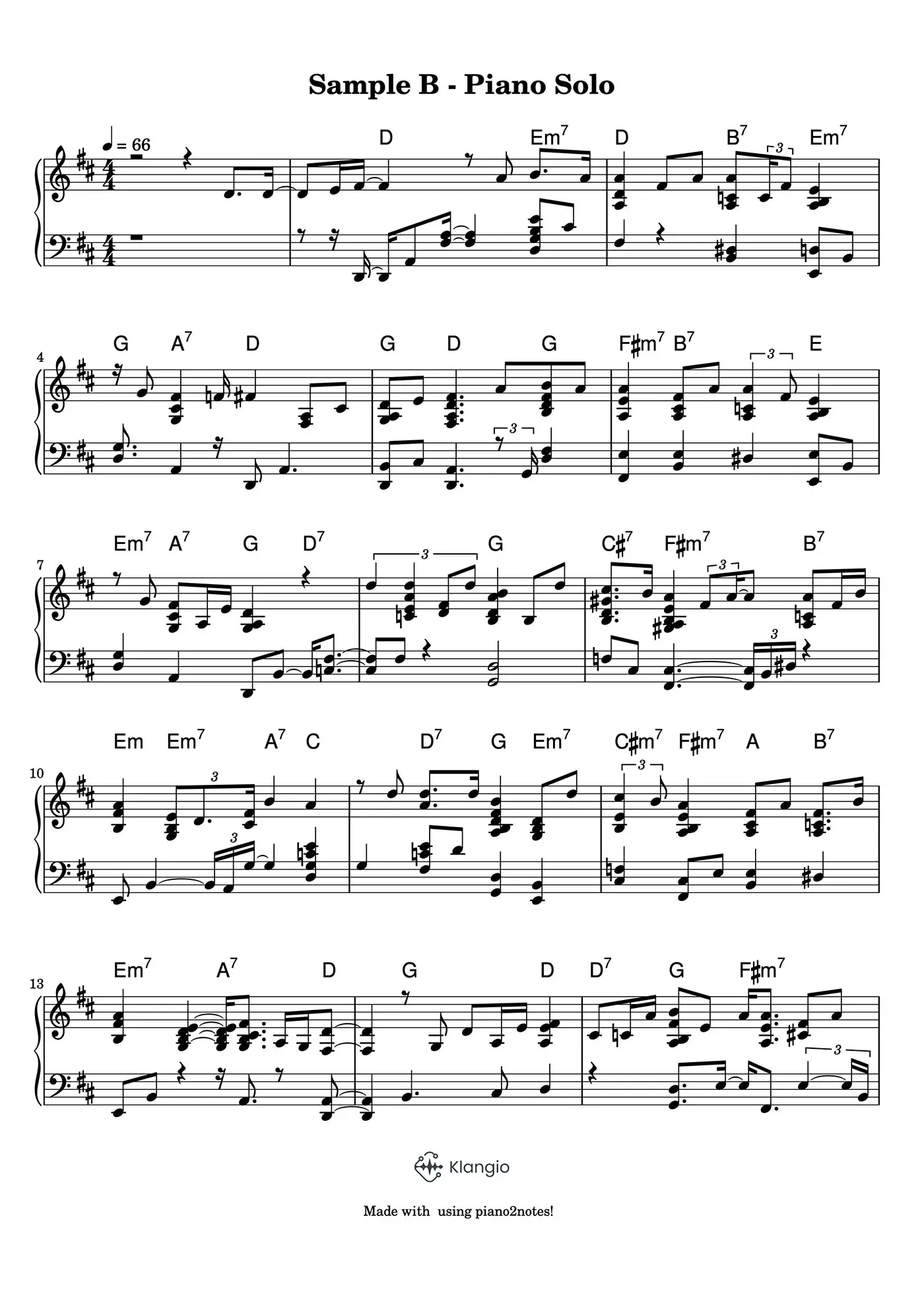

Sample B — Piano Solo: AI transcription (left) vs professional transcription (right), same source audio.
Pitch: Similar to Sample A, the AI detected most pitches reasonably well on clear passages. However, all voices were merged into a single layer again, collapsing the melody and accompaniment into one undifferentiated stream of notes.
Rhythm and meter: The AI produced duplets in places where none exist in the music. The first beat of almost every bar is displaced, meaning downbeats rarely land where they should. For a musician trying to follow along with the recording, this makes the score confusing and disorienting. The arpeggiated passages fared slightly better in this sample compared to Sample A, but the overall rhythmic accuracy remained poor.
Chord symbols: We did not include chord symbols in our transcription of this piece. The AI, however, generated chord labels throughout. Many of these chords are incorrect or irrelevant to what is actually being played.
Musical directions and layout: Same issues as Sample A. No dynamics, no expression markings, no pedal indications. The layout is cluttered and difficult to read.
Playability: As with Sample A, this output is not usable as a performance score. The displaced downbeats alone make it impractical, and correcting the merged voices, wrong rhythms, and incorrect chords would take longer than transcribing the piece from scratch.
About this piece: Sample C is a straightforward vocal melody. This is the kind of piece that even amateur or intermediate music students could transcribe accurately by ear. We chose it specifically because it should be well within AI's capabilities if vocal transcription works at all.


Sample C — Vocal Melody: AI transcription (left) vs professional transcription (right), same source audio.
Melody and pitch: The melody was written on an alto clef, which is an unusual and incorrect choice for a standard vocal part. Most of the pitches were detected correctly, but several passages were omitted entirely, leaving gaps in the melodic line.
Rhythm: Even with a simple single-line melody, the AI struggled to notate the rhythm accurately. Rhythmic values were frequently off, and the overall flow of the melody felt disjointed when reading through the score.
Lyrics: The lyrics are not hyphenated and are poorly aligned to the melody. Melismas (where a single syllable stretches across multiple notes) are missing entirely, making it impossible to sing from the score as written.
Chord symbols: Some of the chord symbols in the AI output are incorrect, which would mislead any accompanist reading from the chart.
Layout: All stems point upward regardless of note position, and rest placements are inconsistent and visually awkward. The overall presentation does not meet basic engraving standards.
Playability: This is a piece that should be simple to get right. The fact that AI struggled with a single vocal line, producing an alto clef notation with missing passages, wrong rhythms, and unaligned lyrics, highlights how far the technology still has to go for vocal transcription.
Across all three samples, the pattern is consistent. AI handles basic pitch detection reasonably well on clean source material but falls short on rhythm, musical directions, and presentation. One recurring issue: AI struggles with pickup notes (anacrusis) and almost never figures out how to start the transcription correctly, which throws off the meter for everything that follows. The gaps only widen as the source material becomes more complex.
When Should You Hire a Professional Transcriber?
If the sheet music will be performed, published, or sold, or if it involves more than one instrument, AI transcription is not sufficient. Professional transcription is faster than correcting AI output for anything beyond a rough pitch reference.
The global sheet music market is valued at $370 million in 2025 and growing, with digital formats now accounting for 56% of adoption (Business Research Insights, 2025). That market exists because musicians, educators, publishers, and performers need reliable sheet music, not rough drafts.
You need a professional transcriber when:
- The score will be performed. Concerts, recitals, auditions, recording sessions. Performers need readable, accurate notation with proper markings.
- You're publishing or selling the sheet music. Publication-quality engraving requires human expertise in spacing, layout, and notation conventions.
- Multiple instruments are involved. Ensemble parts, orchestral reductions, and piano-vocal arrangements require voice separation and clef choices AI can't handle.
- You need customization. Simplified versions, transpositions, fingerings, chord symbols, or custom arrangements are all human skills.
- You want revisions and input. With a professional transcriber, you can request changes: adjust the voicing, simplify a passage, add fingerings, or reformat the layout. With AI, you get what you get, unless you have the skills and software expertise to make the edits yourself.
- The music is rhythmically complex. Jazz, Latin, contemporary classical, film scores, or anything with swing, rubato, or mixed meter.
- You tried AI and it didn't work. If you've spent an hour correcting an AI draft, it's time to let a professional handle it.
What's the Future of Music Transcription?
The most likely future is not AI replacing human transcribers. It is AI handling mechanical pitch extraction while professionals focus on what audio alone cannot reveal: musical intent, rhythmic interpretation, expressive markings, and publication-quality engraving.
The music notation software market is projected to grow from $500 million in 2024 to $1.2 billion by 2033 at a 10.5% CAGR (Verified Market Reports, 2025). AI will keep improving, and it should. Better pitch detection, better rhythm handling, and better export quality will make these tools more useful over time.
But here's what AI can't currently learn from audio alone: musical intent. Why the composer chose that voicing. Whether that note should be legato or detached. Where the phrase breathes. What makes a page turn practical. These decisions require musical understanding, not just signal processing.
The most likely future isn't "AI replaces human transcribers." It's AI handling the mechanical extraction while humans focus on what they do best: interpretation, quality, and making sheet music that musicians actually want to play from.
Sources and Methodology
Accuracy benchmarks and research cited in this article:
- MIREX 2024 Polyphonic Transcription Results. Annual evaluation of automatic music transcription systems on standardized datasets
- Jamshidi et al., 2024. Survey of machine learning techniques in automatic music transcription (arXiv)
- Benetos et al., IEEE Signal Processing Magazine, 2018. Comprehensive survey on automatic music transcription quality dimensions
- Martak et al., EURASIP Journal, 2025. Distribution shift effects on AI transcription accuracy (piano, genre, recording conditions)
- NeurIPS 2025 AMT Challenge. Multi-instrument transcription competition results
- Business Research Insights, 2025. Global sheet music market valuation and trends
- Verified Market Reports, 2025. Music notation software market projections
Our side-by-side test was conducted on March 31, 2026, using Klangio (Piano2Notes / Melody Scanner) on three source recordings. AI output was exported as MusicXML and compared against professional transcription of the same audio by Music Notation Hub transcribers. Evaluation covered pitch accuracy, rhythm and meter, voicing, musical directions, chord symbols, layout, and playability.
What's the Verdict on AI vs Human Transcription?
AI music transcription is a useful tool. It's fast, it's accessible, and it's getting better. For quick MIDI extraction or rough pitch reference, it fills a real need.
But if you need sheet music that a performer can sight-read, a publisher can print, or a student can learn from, AI isn't there yet. The gap in rhythm, expression, playability, and engraving quality is too large to ignore. And the time spent correcting AI output often makes the "free" option more expensive than hiring a professional in the first place.
Key takeaways:
- For performance, publishing, or teaching: hire a professional transcriber
- For rough MIDI extraction or pitch reference: AI is a reasonable starting point
- Correcting AI output typically takes longer than transcribing from scratch
- AI accuracy varies dramatically by source material and drops fast outside solo piano
- The technology is improving, but the gap in rhythm, expression, and engraving remains wide
Need Sheet Music You Can Actually Perform?
We prepare lead sheets, piano transcriptions, piano-vocal arrangements, full-score transcriptions, and custom notation with professional engraving standards and human quality review.
Get a Free QuoteFrequently Asked Questions
Is AI music transcription accurate?
It depends on the source material. AI accuracy ranges from 38% to 96% (MIREX 2024). The 96% figure is for clean, studio-recorded solo piano only. Guitar drops to ~78%, vocals to ~52%, and dense polyphonic mixes to around 38%. Crucially, these benchmarks only measure pitch detection. Rhythm, dynamics, and expression aren't measured or captured at all by current AI tools.
Can AI transcribe polyphonic music?
AI can attempt polyphonic transcription, but accuracy drops significantly. A 2025 Springer study found that genre and recording condition shifts alone can reduce F1 scores by 20–50 percentage points (Martak et al., 2025). Multi-instrument and ensemble recordings remain especially challenging for AI.
How long does professional music transcription take?
A typical 3-minute song takes 1–4 hours of professional work, depending on complexity, instrumentation, and required detail level. The delivered score is finished, with no further editing needed. At Music Notation Hub, standard turnaround is 5–7 business days, with rush delivery available.
Can AI add dynamics and expression markings to sheet music?
No. Current AI transcription tools output notes and note durations only. They don't detect or generate dynamics (pp, ff), tempo markings, pedal indications, articulations, expression text, or chord symbols. These elements require human musical interpretation.
When should I hire a professional transcriber instead of using AI?
Hire a professional when the sheet music needs to be performed, published, or sold. Also when the music involves multiple instruments, complex rhythms, or when you need customization like transpositions, simplified arrangements, or chord symbols. If you've spent more than 30 minutes correcting an AI draft, a professional would likely be faster and cheaper.
Can I use AI to start and then hire a human to finish?
In theory, yes. In practice, the AI output's structural issues (broken XML, wrong voicings, quantized rhythms) often make it faster for a professional to start from the audio directly. If you'd like to try this approach, we offer a dedicated AI sheet music cleanup service. Send both the AI file and the original audio so the transcriber can choose the most efficient workflow.
How much does professional music transcription cost?
Professional transcription typically starts around $39 USD for short, simple pieces. Pricing depends on length, complexity, instrumentation, and turnaround time. At Music Notation Hub, you can get an instant estimate using our online pricing calculator. No hidden fees or surprises.